Industry Sour
by Chris Rybak
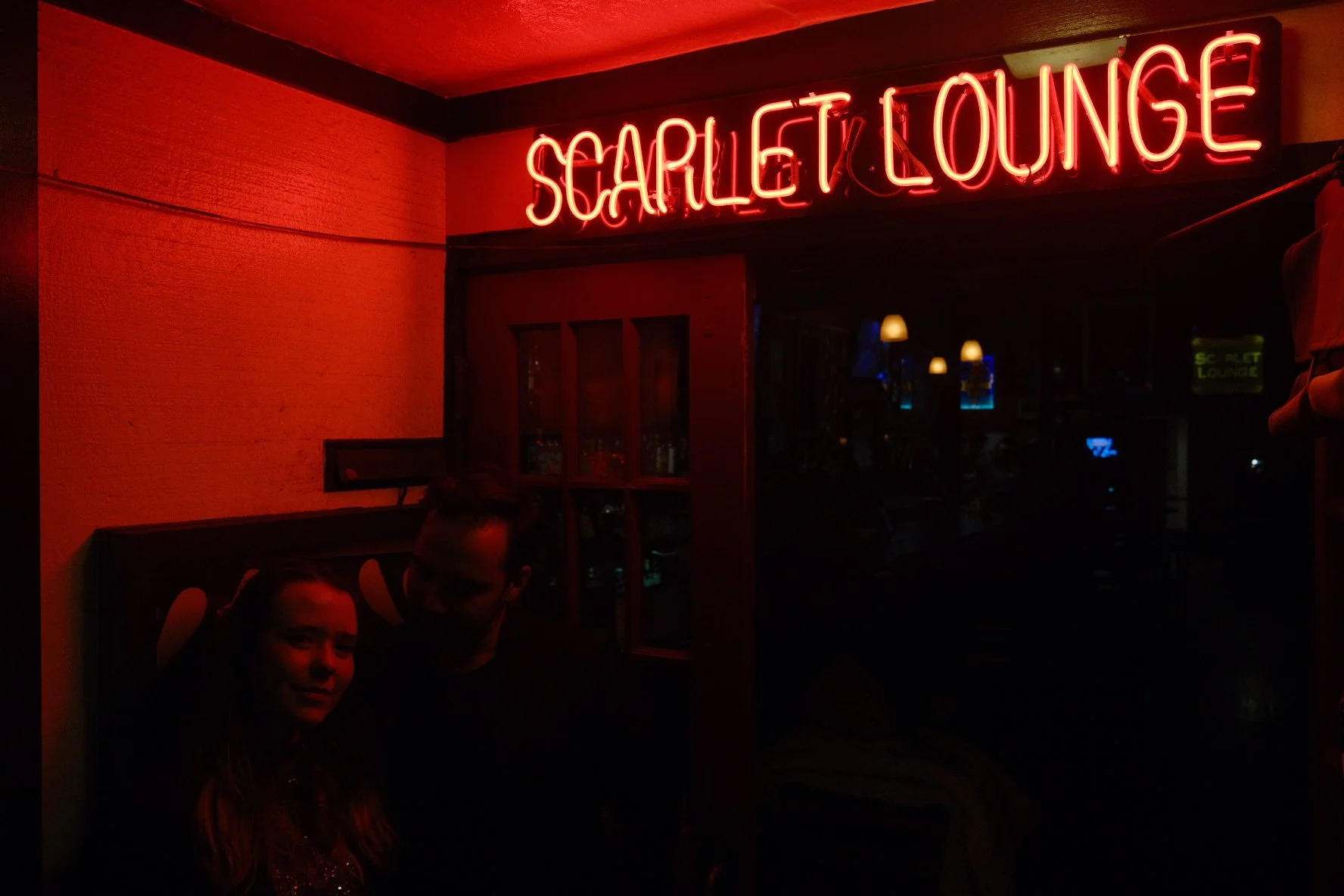
Before the fire and flood, Scarlet Lounge was busy. I had opened the place a year ago, turning a shop that sold coffins into a dive bar two blocks from my old church. Last night, I think, Guinevere, Sadie and Travis sat beneath a dim lamp, sharing stories of their baleful encounters with the world outside of San Francisco. They had made this den their new haunt because they knew me, kind of, from an A.A. book club; I used to set up the rooms for their meetings. Though I wasn’t in recovery, unfolding those chairs and brewing their coffee felt like preparing to host your own birthday party, all while knowing you wouldn’t be coming. Not so long ago, I had washed their feet to celebrate a streak of sobriety, and now here they were, watching the ice in their cocktails melt. This was maybe an hour before the tsunami siren.
“It was so hot in Chicago,” said Guinevere, not a young woman, chewing her compostable straw. “We were at the Cubs game, and a girl fainted. Waiting in line for a funnel cake, and then she just dropped. Bag of bones. I think she broke a rib on the way down.”
“Or because of the way down,” offered Travis. He had been a host of the twelve-step’s running club, a teacher of of hourly prayer and death-to-self, but over time his stamina for these slipped away. “I don’t mean to split hairs,” he added, with woe.
Mixing a third, and very unnecessary Negroni for Guinevere, I asked her if the fainted girl woke up.
“Medics came quick and took her away. These buff guys put her on a cot like she was a knocked out princess. I thought, sign me up for that! But the line kept moving, and we all got funnel cakes.” In a show of virility, she made her hands into fists when she said, ‘Sign me up for that.’ Her hands were thin and her skin almost see through, a graying silicon around the knuckles.
Sadie said, “If I went to a baseball game, I’d faint from boredom. Give me the cot and a buff guy, good lord.”
“It’s not so slow anymore, with the pitch clock,” Travis pleaded.
“Maybe you’re right.” Sadie’s courtships with sobriety led her to swear off liquor and only drink wine, so here it’s chardonnay and soda, rocks and salt, but if she asked me for my liver, I’d say get the anesthesia. We watched her lick the salt off her glass. Like buried nuclear waste, Travis and I had a crush on Sadie that, through the years, had been tamed to fit into a subterranean container, but if the earth above it was ever churned it would likely result in our bleeding from the ears. Was how we’d once described it, after she left with the drummer of a punk band.
“When my father was still a big drinker,” started Guinevere, raising the drink to her lips. She took a sip, set it back on the coaster, and said nothing more to the new, stiff silence.
Then a fire alarm rang. Not in the bar, but near. It was an old fashioned alarm, metal smacking metal, calling out from a distant past that was coming back around, from the future. Forgive the metaphysics. But I’m remembering this from a chair I never imagined my ass in. I used to be a pastor with hairy arms, sermons handwritten in a moleskin, an almost awkward ability to remember your name. This morning I asked the nurse, what knocked me out? And where are my friends? My nurse is a man. He’s jacked like a marine and he said it’s not a time for questions, it’s time to get me a new IV.
So if you see Sadie, tell her I got the cot and a buff guy, good lord.
You could hear the alarm only in between songs and lulls in conversation. I went outside into a foggy summer evening. It was Sunday, and Friday’d been the one year anniversary of my opening the bar, and of my sobriety, so I’d tied helium balloons to the doorknob. Fun. They were starting to sag but the wind pulled them taut and they looked like tired boxers, hugging and batting each other, waiting for the bell. Beside our building is a derelict concert venue, always with goth kids in war boots waiting in line for shows that never seem to start. I watched them pass lighters and pens, their shoulders angled from each other in the slightest distrust. Twice their age, I was starting to envy how their unchallenged youth made them look like seraphs afloat in their own haze.
The alarm was ringing from the pet-fish shop which was oddly on the floor above my bar. It would do this sometimes: six minutes on, three minutes off, but in my first year here, never a flame. Some blocks to the west, a firetruck howled, but probably not for this. Then, across the street, I saw my ex-wife turn the corner and walk into Scarlet. She wore a corduroy jacket we got on our honeymoon and a bucket hat she stitched from Easter-colored beach towels. Her name’s Madison, and like every other week she does this–she brings me pad thai, or muffins and lemons, or some useless belonging I left in our condo, and it’s weird. It’s really weird. She said she’d always love me, and she’s doing it. Makes me wonder if this woman is really a changeling, a swapped soul or a spooky kind of rebirth, even though it’s been she, lately, who’s into that stuff.
I went back inside and checked first on the trinity. The maze-grid of wrinkles that crown Guinevere’s forehead, Sadie’s obscenely lavender perfume, Travis’ eyes, sad like an elephant, when she told him about who she’s meeting tonight.
Guinevere said, “It was the hottest day I ever lived in.”
“Hold my hands,” replied Sadie. “My hands just got cold, for no reason.” She’s almost forty, and has a thin, wide mouth and galactic blue eyes and a desperate ability to approve of whoever is in front of her; it’s like she believes in nothing to the point that it’s horse-shoed around to the higher love of redwoods and monks. I’ve never known what to make of her diluted compassions–she might be a prophet, or a saint, and this haunts me. Or what haunts me is: I used to be like that. It was my job. An associate pastor at the Richmond Presbyterian Chapel, I was paid to befriend sinners, marry and bury, arrange Fellowship Hall for A.A. meetings. The ones Sadie went to. Every week, she would show up way early, when it was just me and her. This was probably because of a bus schedule, and not to torment me, but either way, I’d be vacuuming the rugs and stirring the lemonade and she’d be waiting in the corner, suppressing a smile, beautiful in a way that pissed me off. My best years were her worst, and like some secret pact, she doesn’t like to acknowledge that she knew me in that past life. She compares it to a dream, but I remember it well.
Their drinks were empty and I gave them half shots of Mallort, but Sadie, some Port. The digital juke box played a reggaeton remix of “Take Me Home Country Road.” Three TVs showed wildfires, Rick & Morty, the Seinfeld that declares the summer of George. This was my place and I was its mother.
Like a marble rolling along a slanted floor, I went to Maddy. Her fingernails were long and caked with clay, this month’s phase.
She took my hands and said, “Eternity is in moments, yet man is in eternity.”
“I don’t know about that, Mads.”
“You know who just said that?”
“A poet, a lark, a chat bot god.” I pulled back my hands and shook off the clay dust.
“I went to church just now. They’re doing a five o’clock service, lets you sleep in, do the farmer’s market.”
“The Entrepreneurial Chapel.”
“It’s not so bad. The new pastor told us, ‘We contain a magic that we cannot touch.’”
“Sounds like bullshit. Sounds like Rilke.”
“He reminded me of you. Words of…clouding exactness, that hide as much as they find.”
“Well if he’s going to quote the old drunk preacher, he should get it right.”
“Which part?”
“Eternity is in man, yet man is in a moment.”
“Hon, what the fuck does that mean?”
“It doesn’t mean anything. But it’s my rain drop donation to three millennia of theological thought.”
“That was you?”
“It is me.”
“Now I know. But you’ve had a big year, love. I brought you a gift.”
Was the lipstick for church? Was she in such a rush that she didn’t wash her hands after pottery but she did find time to apply lipstick before coming to her ex-husband’s bar–
From a tote bag she pulled a portable radio: Sony, vintage, old but cool. It was a good gift. She remembered my affection for simple gadgets, and that I’d stopped drinking as a petty atonement for giving my life to a bar. I turned it on, static and jazz, sounded like it was coming from the moon. “You’re annoying,” was all I could say, but she reflected my smile. Thick, brown eye brows, savage and lovely, fading into her wrinkled squint. I imagined her at a hundred years old. “Want a beer, or a Paper Plane?”
“My new friend, he’s a bartender too, he makes this drink called an Industry Sour.”
“If you marry a bartender, I’ll kill’em. My heart rate wouldn’t rise and I’d nap an hour later. What’s this drink?”
“Don’t joke! It’s an Industry Sour, people in your line of work love it.”
“My line of work. What the hell is an Industry Sour?”
“Fernet and something, he says it tastes like shame. It’s easy, look it up.”
“Sour and shame. He explained this, what, on your couch?”
She stuck her tongue against her cheek, a tell that she'll give you one more chance to fuck off. “He explained that sometimes, he regrets that this work is his only way to stay in the city. He said he feels trapped. You two could be friends.” Her face was blue in the glow from her phone. “And yes, it was on the couch during small groups. The ones we used to host.”
I started on her drink, the alarm rang anew. Speaking as though the messenger of a treaty, she said, “It’s Fernet, Chartreuse, lemon, simple, egg white, salt, bitters. There, and what’s this alarm?”
“Just the aquarium.” I handed her the Paper Plane, my spine felt firm. Madison Doolittle. She’s taller than I am and her big red hair frames her face like a lion and when she walked out of my life, god had just died. It was a quiet death, without crash or fanfare, no more explosive than the sound of a needle being lifted from a record. Around that time, things were bad and I wanted them worse. Divorced and ever half-drunk, I craved fallout and pain, the bottomless emptiness of apostates and eunuchs. She was, to me, such a treat. She made two grand a month from commissions to paint people’s (often dead) pets. We shared a self-righteous hatred for Wes Anderson films, Dustbowl-chic interior design, oversauced pizza, lines for croissants. I struggled to clean dishes and she left brushes, scissors, even razors on the couch and carpet, and about those we argued. She’d say, ‘Everyone wants to fall in love with an artist, but no one wants to live around art.’ For a little while, we had it, and the cruelty of its brevity confirmed it was possible.
She left because I left the church; it was almost that simple. She’d married a pastor, not a barman, and she would not follow me away from the narrow path that leads to Life. As for my own alcoholism, it was less of a shit storm, more of a slow rising sun. I don’t think it played a big role in my big dumb demise. What did? Theology. Laugh, but as the country eroded and the forests burned and tech continued to mutate, Maddy’s faith became more cosmic as mine became more embodied. The woman who once brought shower trucks to the homeless had taken to posting of repentance and rapture, forsaking the poor in spirit for the rich in apocalyptic fervor. With this stuff she ruined hangouts and holidays to the point that our friends didn’t recognize us. I was changing too, but mostly by disavowing the afterlife. ‘Heaven is not waiting for us to ascend to it,’ I preached in my final sermon. ‘It is waiting for us to descend, as Christ. There will be no rapture, for salvation was never an event of escape.’ Robe and microphone were mine as I aired out how wrong I thought she was, how sad that her goodness had been infected by some viral delirium. Then I gave back those borrowed things, and her.
‘Your words were a well for dried out souls,’ is what she told me, three years ago, when I quit church. ‘And who has poisoned your well?’ She asked if I had lost my faith, if there was some ugly sin I wanted to beat to the end. Was I a thief, an adulterer, a perv. It wasn’t anything like that; it couldn’t be put in those terms. Dry wells aren’t poisoned. Just dry
Sadie returned from the bathroom in mascara and lip gloss, her eyes glowing out from her tired complexion like twin jewels dropped in a storm drain. I watched her choose a new seat, near the door, near me. She ran her fingers through her hair and smacked her face to wake up. Travis helped Guinevere from her stool and they left arm-in-arm, wishing Sadie luck.
“Just remember,” said Gwen. “He’s a shit, until he’s not. We love you.”
The bar was still busy; people were staring at me with credit cards in their fingers. George, in Seinfeld, was hospitalized now, and a fire named Nehemiah was ten percent contained.
I said to Sadie, “You changed.”
“Didn’t want Trav to think I wore it for him. Is that bad?”
“He told me he’d walk barefoot across a mile of legos to hear you fart through a walkie talkie.”
“No! Ew! What?”
I shook my head, suppressed a smile. It was I who said that to Trav. “Meeting someone?”
“My first-first date of the year.”
“Who is he?”
“We’ll find out. I met him in the weirdest place, traffic school. He can’t drive slow and I can’t drive straight. The universe craves balance. I think his name’s Leon.”
“Chard and soda?”
She leaned in and yell-whispered, “What did your ex want—Industry Sour!”
“Now, wait. That’s real booze.”
She frowned like a melting glacier. “Please?”
“For you, yes.”
She laughed and I could’ve died. When I set out as a minister, I promised thirty years. Lasted six. As I made her drink my hands were shaking and when I set it before her I kept my head down.
I told her, “Wait. Let me caramelize a lemon peel.”
But then I tended to the masses. Next door, the punk show started and you could feel the soundproof walls bending by the kick drum. The fire alarm was completely swallowed. Everything continued. Maddy, rejected by The New Yorker five thousand times, tied up her hair and drew a comic of a woman at the beach, holding a conch shell to her ear, captioned: ‘Yooouuu left the stove on.’ I told her that’s the one. Some goth kids came in and asked if we had food. I pointed to the Pringles, they left. In the weightless pocket of drink making, I was alright. People tipped on inflated prices, the jukebox played Orbison, I was stupid in love with at least one person in this small, warm bar. Eternity, man, moment. If you don’t go to heaven before you die, you won’t when you do. Even now, I believe that.
Sadie was still waiting for the lemon peel when her date showed up. My first thought was his face resembled hers in the way dogma resembles faith. Sharp cheeks, wide nose, gray hair under a green trucker hat. I recognized him, maybe, from an implacable memory I could not trust, so I searched my brain for a replacement. Did he look like Mark Ruffalo? Had I rubbed ash on his forehead some long ago Lent? I polished glasses, closed tabs, made the guy wait. When I imagine really going for it with Sadie, it always seems to involve: running away. We are singing on the road, fucking in tents, counting Euros like they measure our future. When people hear what I used to do, they always ask the same things: Are you still Christian? Do you believe in God? But if I could preach one more time, I’d say salvation is found in escape.
I stood across the bar from Sadie’s date. “Hey man, I.D. please.” He looked at me with a stunned smile, and I hated how he licked his lips. He might’ve used to be handsome, some kind of ball player, ostensibly blue collar. Probably fifty years old.
Guy pulled out a money clip.
In a kind, pleading voice, endearing and condescending, Sadie said my name.
He flipped through his cash. “I didn’t bring it, man. Last time I got carded, Bush was…the office.”
“No I.D.?”
Sadie laughed. “This is a funny bit!”
“What’s your name?” I asked. “Where you from?” I didn’t know what I was doing.
“You know, I came here to tell her all that.”
“Just haven’t seen you before.”
“Here I am.”
Sadie said, “Wait, do you guys know each other?”
What took my eyes from hers was Maddy’s red hair, flashing behind Sadie’s. She was yelling, it seemed, but I could barely hear her from down in the hole I’d dug.
“Oh no, oh no, there’s a big ass fight.”
So then came the riot. Her date walked out to behold the fights and the rest of us followed–like three dozen goth kids had erupted from the concert hall and into the street, stumbling backwards and diagonally like dispossessed fairies inverting a difficult dance. Under the urine streetlight, they were brawling, kind of, but there seemed no common enemy, no will behind their one-armed tackles. Briefly, their collective swell took on a clockwise rotation around a vague center, but soon their momentum scattered, as if North had been lost or replaced. They arranged and deranged themselves into three or five nebulous clusters of shoving and t-shirt pulling, and as I looked for a fight to break up, I found not one. Some kids gave a recycling bin the kick they would not give their neighbor. Someone helped up a knocked down buddy only to push them back down again. “Sike, bitch,” I heard. “Smurf cuck,” as well. An especially pale girl with her arms cross-hugging her shoulders, drifting among the mayhem, called, “Which one of you soft dicks knocked off my glasses.” Maddy went and joined her, helped her look. I remember thinking, in thirty minutes these kids’ll be googling, Boba near me.
I saw the date sitting back in the bar, but Sadie was standing in the doorway. My eyes found hers and she didn’t look okay. She beckoned me to come close and I put my ear to her mouth.
She told me, “I think he spiked my drink.”
I stared at him, resting his chin on his hand as though bored. Was that where I’d seen him? The text chain of neighborhood bars, sharing pics of personas non grata. The 86 list. In the empty room he looked pensive and remarkably alone. I waved Maddy over and repeated what I’d heard.
Sadie said, “He went in before me, and when I saw him, he was pulling his hand back from my drink. From above my drink. I didn’t really see it. I didn’t know what to say.”
“Did you drink it?” I asked.
“No, I was looking for you.”
I went to him with the pace of an unhurried judge. We were face to face, and I felt the words leaving my mouth before my tongue moved to say them.
“What’s this?” I barked, pointing at the drink. “What the hell is in this?”
“You made it.”
“Who are you. You’ve never been here.”
He looked amused and languid, stretching silence as though it created time. “Are you okay?”
“Yup.”
“You’re not making a lot of sense.”
“What’s your name?”
“I’m not here for you. Neither is she.”
I angled my shoulder to hit him, but didn’t.
“Did you spike her drink? Are you some fucking creep?”
“I could ask you that.”
“Holy shit fuck off did you spike the drink?”
He straightened his posture and cracked his spine. “There are signs in the bathroom, say you have test kits. You could test it. And see if I’m a creep.”
“And do what, wait and see?” I actually dug my fingers between his chin and palm. “Lift up your head. Stop leaning on your hand.”
He grabbed my wrist and started to laugh. “How does this end?”
I pulled back my hand and reached for the drugged drink. The egg white was chalky on my teeth, and I felt the little ice chips melting against my gums. So disembodied, my throat was chugging the drink. Taking and taking that familiar warmth, that ocean of shame. I slammed the empty glass. “What happens now?”
He stood to leave. “Watch out.”
“What would I watch out for?”
“That’s what you’re watching out for.”
The asshole stormed out, and I looked to Sadie’s face, its tattered beauty, a reflection of my pastoral corpse. I know that doesn’t make sense. It’s just what I think. All the time.
Around then, I think, every phone rang. Entranced by my big little rage, it took me a second to realize that the noise coming from all around was also coming from my pocket. I went to Sadie, beside Maddy, watching from the doorway. Outside we saw a kid look up to the sky, his neck arched back in an instant snap as though inviting an alien abduction. The alert read the basic stuff: earthquake detected, tsunami warning in effect, evacuate immediately, you are in danger. All caps and yellow triangles, etc, etc. Something flickered. Reality’s cousin.
Then the real siren cried. The tsunami siren. An unreal event of sound and fear declaring your time as the exception is up.
United by the crisis of its new disposition, the mob scattered quickly, grudges were forgotten. We were the only people still in the bar, and I reached and recoiled at things to save: the cash in the drawer, the Pappy van Winkle, a framed original of a Pollock sketch. And the radio, definitely the radio. In that manic hurry it was hard to know the use of things in the world we’d been told was approaching. For better or worse, I took those four, picked up my keys, and felt a cool relief when I saw Maddy and Sadie, clutching each other, waiting for me. We went outside. The siren made the air a monolith of sound. From habit I locked up the bar. The balloons were waist high, and the street had cleared out. I remembered that Maddy and I do not own a car.
We looked at Sadie. “Do you have a car?”
Her mouth opened and closed. “I do not.”
Maddy was like, stretching her hips with hoola-hoop swings. She said, “RAPTURE TIME! Thy will be done.”
Sadie, choosing life, said, “Or we could hitch hike to safety.”
I stuck my fingers in my ears and yelled, “I need to think.”
So among us an argument ensued. Maddy said if this is the big one then only the helicoptered will survive, but Sadie insisted some kind soul would drive us up the big hill in the Castro. What did I say? Definitely something. What I know for sure is I was pouring the whisky in my mouth. Pappy van Winkel, the best in the world. It lit me up with a feral joy, and the women watched with regret.
When we’d agreed to hitch hike, a firetruck came. In the context of impending catastrophe, the truck made sense, and didn’t. It seemed an angelic arrival, and also a state-mandated procedural thing that had nothing to do with us. The truck was silent and it parked by my bar and I went to the driver, clueless and desperate. He was young and his helmet was cartoonishly big. He asked me, “Did you call?”
The insanity of the question. “Not this time,” said my mouth.
He hopped down from his seat. His buddies unraveled the hose and leaned a ladder against the building. One guy had an axe, another, a beer. Looking past me, he asked, “Did one of you call?”
I turned and saw Sadie, raising her hand with a child’s excitement. “Oh!” she said. “I did.”
We all sounded like idiots, yelling over the siren.
The fireman asked, “Is this your building?”
“You called?” I screamed.
“Yeah,” she said.
“What do you mean?”
Fireman asked if anyone was inside, and Sadie pointed up to the fish shop. “I dunno. But I saw smoke. So I thought if I called the fire department, which honestly did need to happen, the fighting would stop, but without cops.”
“When did you call?” I asked.
“I don’t know.”
“Before or after you got drugged!”
“I guess before. I didn’t drink it.”
I yelled so loud, “Well someone did.”
The fireman told us, “You should get going.”
I wheeled around to face him. The whisky was a wet oven in my stomach. “Why are you here. Don’t tsunamis put out fires. Shouldn’t you be saving yourselves. I mean it’s an aquarium, for fuck’s sake. Are you really gonna hose down a room full of fish tanks, with a fucking tsunami on the way. Oh my god, man. Oh my god.”
Maddy pointed to the fish shop above my bar, which was, in fact, on fire. Smoke was coming from the windows, so on and so forth. Then she took the bottle from my hand, and I started to cry. The bar had a low ceiling that kept the place warm, and this would open the pores of the wood in a bloom of humor and loss, story and bourbon, touch and belief, each pollinating the other. But memories are not words, and naming the feeling does not call it back.
So we were in some pathetic group hug when the shitty Prius came and saved us. It was Travis, with Guinevere in the passenger seat, a little dog on her lap.
“You’re here,” said Travis, wearing actual ski goggles. “Let’s go, right now.”
“Wait, you’ve been drinking,” said Sadie. “Oh shoot, we all have.”
Gwen clapped twice. “Storms a-comin.”
We pulled away and I watched the fire hose launch its rainbow at my Scarlet Lounge. Quickly and easily it was completely soaked, damned and saved. As we turned the corner I felt reborn, hammered with awe, a feeling that more is possible. The events of that night bore no relation to what came before it, and if I had understood this madness would have the last say, I would have lived differently. I would’ve stayed in the pulpit, half alive and partially beloved, because it was better than this man, in a moment, who poisoned my empty well. “Me,” I said to no one. “It was always me.”
“When my father was still a big drinker,” started Guinevere, rubbing the memory from her temples. “He would hold me by the cheeks and tell me, ‘I’m not your real dad, don’t you ever forget it.’ I would go a long time not thinking about it. But that doesn’t mean I ever forgot it. Because look, here I am, saying it now.”
My heart was pounding and my sweat was cold and my vision was blurry at the edges. When I finally looked down, Sadie was holding my hand. Maddy was holding Guinevere’s. I put mine on Travis’ shoulder.
Sadie said, “Can you pray for us pastor? We need you to pray.”
So I did. I talked to God like I used to, and pretty soon, I was out.